
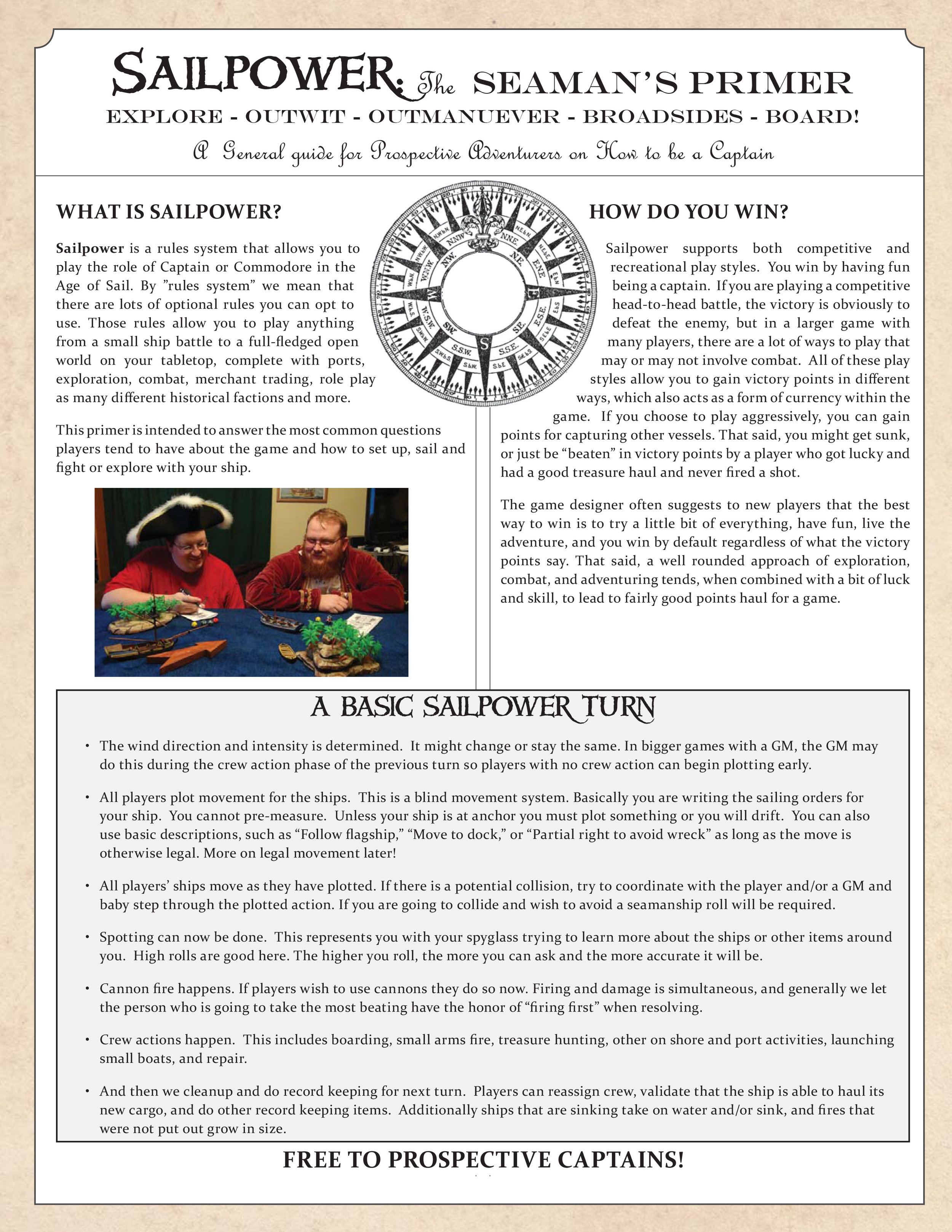
Sailpower 2.0: Fun Scale Combat in the Age of Sail
Are you the master of all commanders? Are you the scurviest of sea dogs? Have you ever secretly felt you’d have made a great pirate or could have defeated the great sea captains in a ship to ship duel?
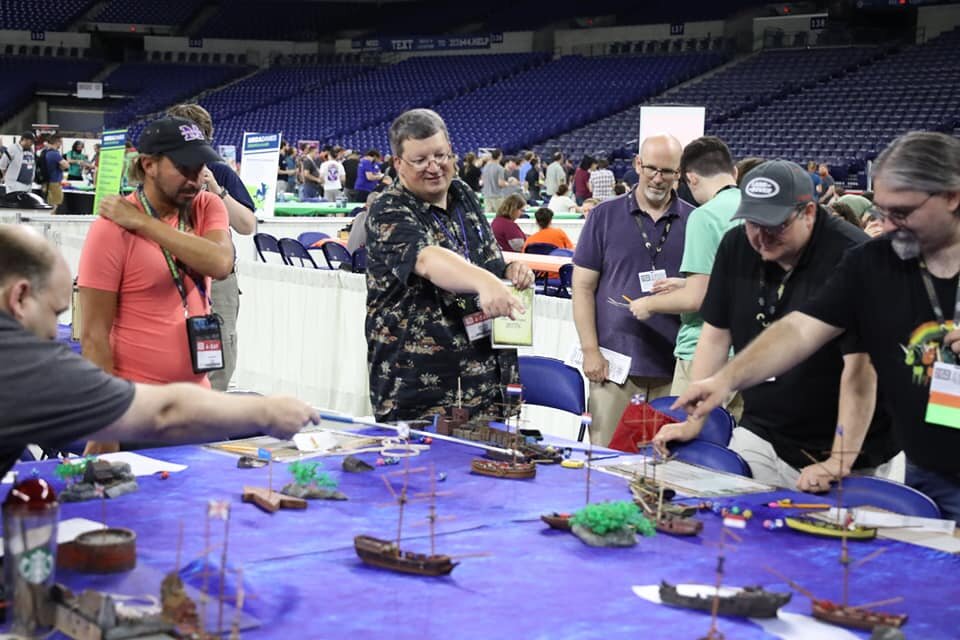
Sailpower is a miniatures game that allows the players to take on the role of a captain in the Age of Sail. Command small ships, large ships or even a whole squadron. It’s your call! Battle other ships, or embark on a mission seeking plunder and riches while giving your enemies the slip. Sailpower is a complete system designed to support fast paced sea action, exploration and adventure. You can play Sailpower on a small table with a couple of ships, a big table with many ships, or even a floor battle with your “sea” covering the whole room!
You can purchase the Sailpower 2.0
rulebook here or pdf here
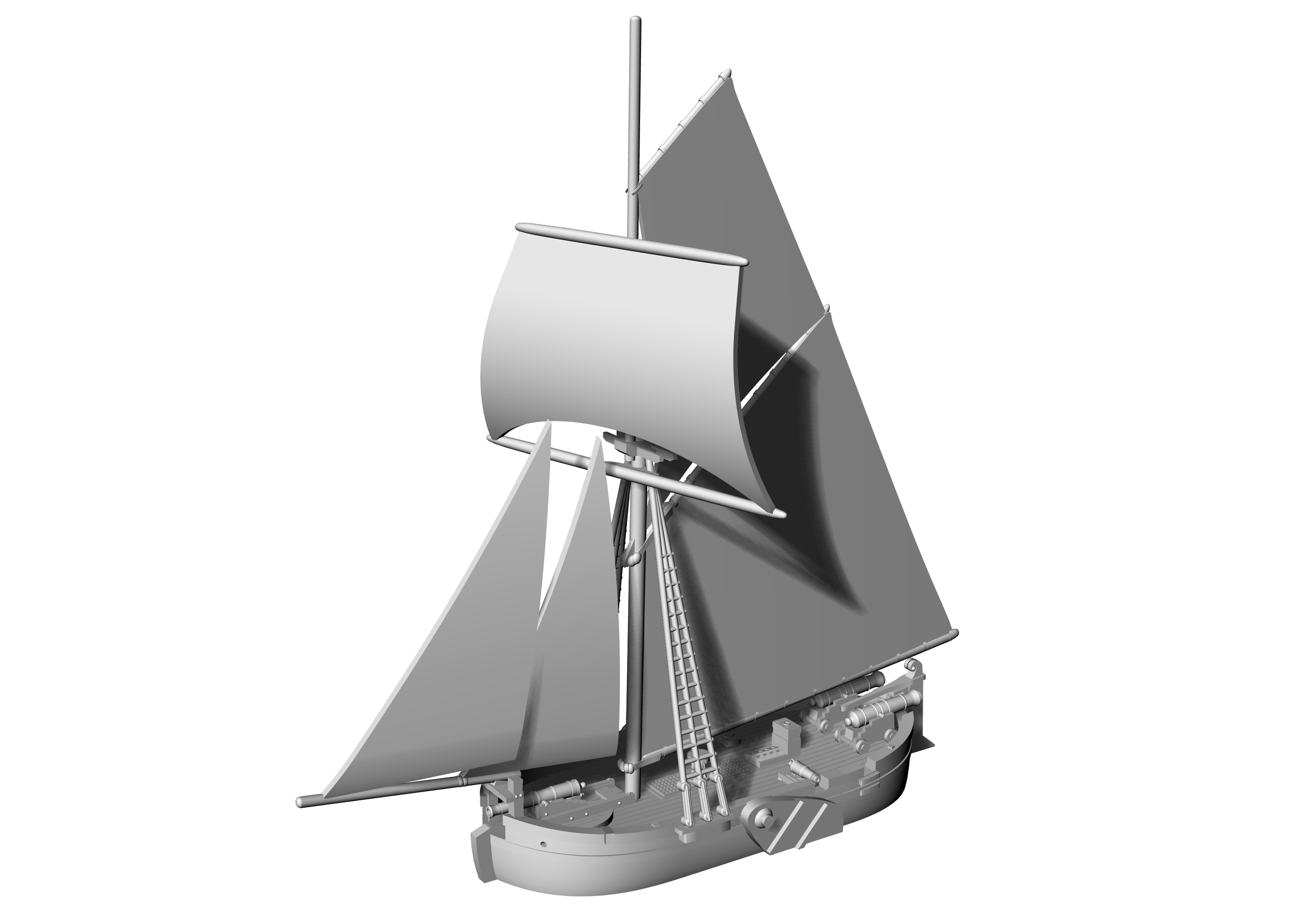
6MM scale Captain’s Edition : This is the latest 6MM version of this kit featuring MSLA resin 3D printed hull, masts, shrouds and sails. The kit features an improved resin that has high detail but maintains part flexibility. The goal of the Captain’s Edition is to get a model on the table for gameplay in a faster manner then previous versions.
6MM scale HarborMaster Edition : This is a legacy version of this kit. 3D printed in Hi Res SLA, featuring wood and floral wire mast construction. The kit comes unpainted and unassembled. This kit type is ideal for more skilled modelers who plan to rig and/or make make sail prom paper, or want to reflect the ship as it would appear in a harbor not under sail. If this version is out of stock it may be available by contacting us for a special order.
This kit comes in two versions… For later era games the Long guns and carronades versions would be ideal and you can mix in the other version for variety. For earlier era games, we offer a Long Guns and cannons version (no carronades).
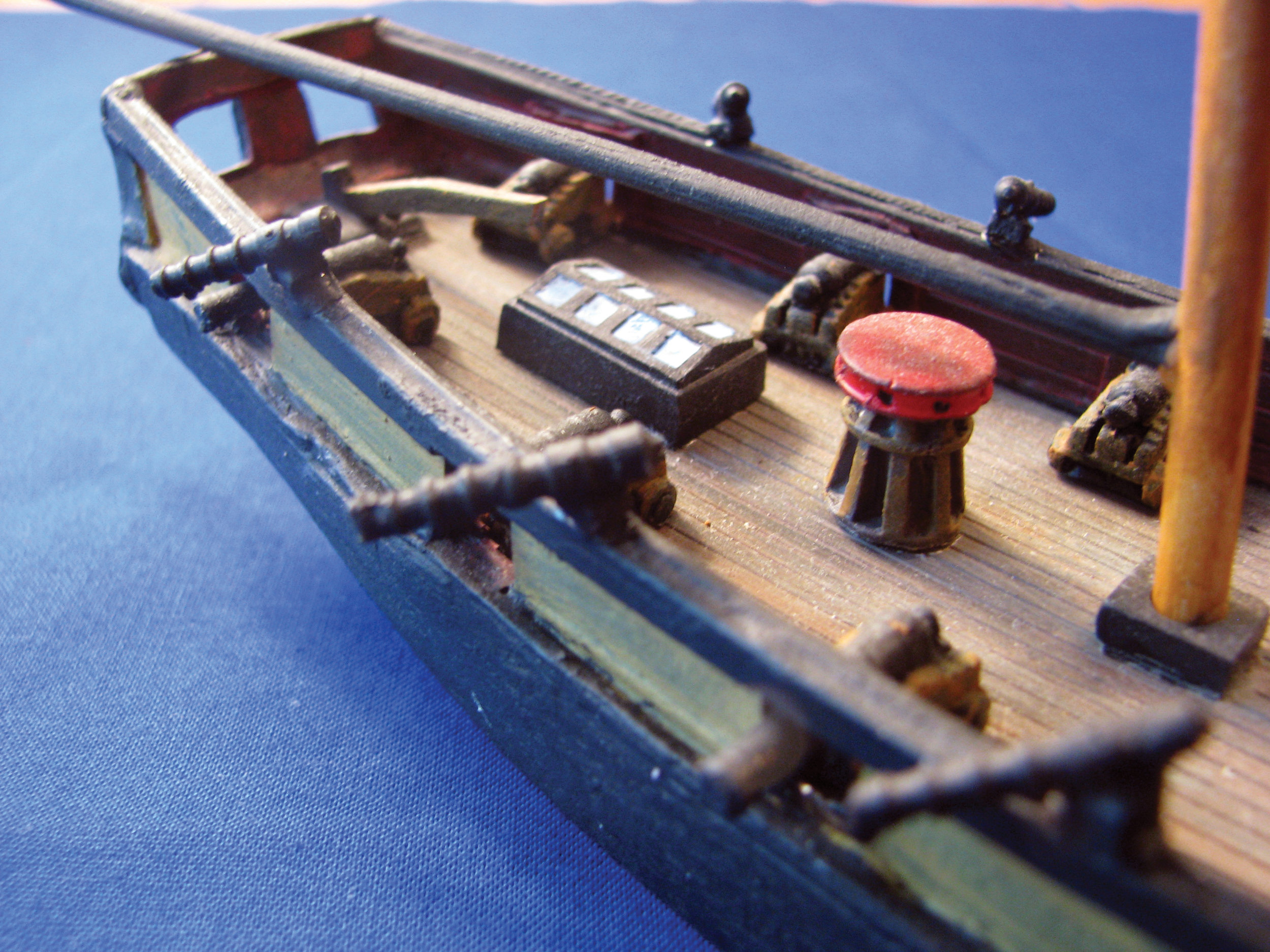
Historic ship type: Dutch Navy gaff/sloop rigged gunboat modeled after Gunboat 2 which blew up and sank February 5, 1831 but is more generally intended to represent any number of period gunboats.
Design background and construction details: A gunboat is generally a small ship fitted with a single or a few large guns. The gunboat could be built quickly and due to shallow draft operate near shore to support ground forces or in a defensive capacity. They could also serve as coastal/harbor defensive vessels and be used to interdict smugglers. This gunboat is based on traditional Dutch shallow draft designs. Literally thousands of craft of this general size and shape were built for the Dutch inland/coastal cargo trade. When designing gunboats, the wide beam, relatively low freeboard and sturdy construction also made them perfectly suitable to carry large guns on deck. The Dutch navy used gunboats like this for hundreds of years with only minor changes.
Dutch gunboats such as this were quite heavily armed for their size with a 30 pound forward facing gun and two slight lighter aft facing guns. The aft guns were set up to be switchable from stern chasers to the sides. In addition, she was also fitted with mounts for 4 swivel guns. As configured in the 1800’s she likely could not manage any additional gun weight thus the switchable guns. Prior to the creation of carronades, these ships carried lighter guns thus could use all ports.
The Dutch trade ships these designs were based on were fitted with a simple sloop rig consisting of a gaff sloop main sail and a few jibs. For naval service, they were upgraded with a more complex rig that allowed her to carry more sail and react to conditions and enemy movement better. This gunboat is flat bottomed with a very shallow draft and the signature Dutch leeboards on each side, which, when lowered, provide the side force that keeps her from being set sideways when sailing to windward. While the hull is not very sleek, this tried and true design and sailed well. In civilian trade, this general design was still in use up to the early 1900’s!
This ship carried long sweeps (oars) and in becalmed conditions could still maneuver. While she had little space on deck for one she probably towed a launch that could be used to board other vessels during inspections.

This ship is perfect for bringing a small naval cutter to your tabletop naval game. This ship is intended to be a more historical spiritual successor and upgrade/replacement for a basic 8-gun flush deck sloop kit that Sea Dog Game Studios had offered for a number of years as a basic starter warship for use with the Sailpower game. This is designed so that the base stats for the flush 8 sloops could still be used, or if advanced players desire, they could play a similar ship that is a little more specific to a historical example in nature.
There are two versions available:
6MM scale Captain’s Edition : This is the latest 6MM version of this kit featuring MSLA resin 3D printed hull, masts, shrouds and sails. The kit features an improved resin that has high detail but maintains part flexibility. The goal of the Captain’s Edition is to get a model on the table for gameplay in a faster manner then previous versions.
15-20MM scale: This kit features a FDM 3D printed hull, with hi res SLA printed detail parts and wood dowels for mast and spars. Paper sails, flags and rigging may be made by the builder but are not included with the kit. The kit comes unpainted and unassembled.
Historic ship type: This ship is based largely on the cutter Sherbourne. Typical of smaller cutters of 1700’s
Cutters evolved during the 1700’s on the coastal regions in southeast England as swift channel vessels. With the massive amount of canvas, disproportionately large area of sail for their size, and a sleek hull, they quickly gained a deserved reputation for their speed, which was quickly noticed by smugglers who soon adopted the speedy cutter as the preferred smuggling craft. In turn, cutters were employed by the British Customs Service to counter smugglers. Cutters were also used by the navy for patrolling and scouting and to carry important dispatches, and military orders around to the various reaches of the English naval presence. They also were commonly used as privateers.
The Sherbourne was built as a revenue vessel for the Customs Service. She was designed by Sir Thomas Slade, the designer of HMS Victory of Trafalgar fame, and was built and launched in 1763. After over 20-years service under multiple captains, Sherbourne was sold in 1784 a remarkably long career for such a small vessel. The historic Sherbourne was 54' 6" long, 19' wide and had a draught of 8' 11". She carried a compliment of 30 men and was 85 tons. Armament consisted of eight 3-pounder carriage guns (LC) and 10 swivel guns (R). Note: Swivel guns are not included with this kit but available separately for the 15-20mm version.
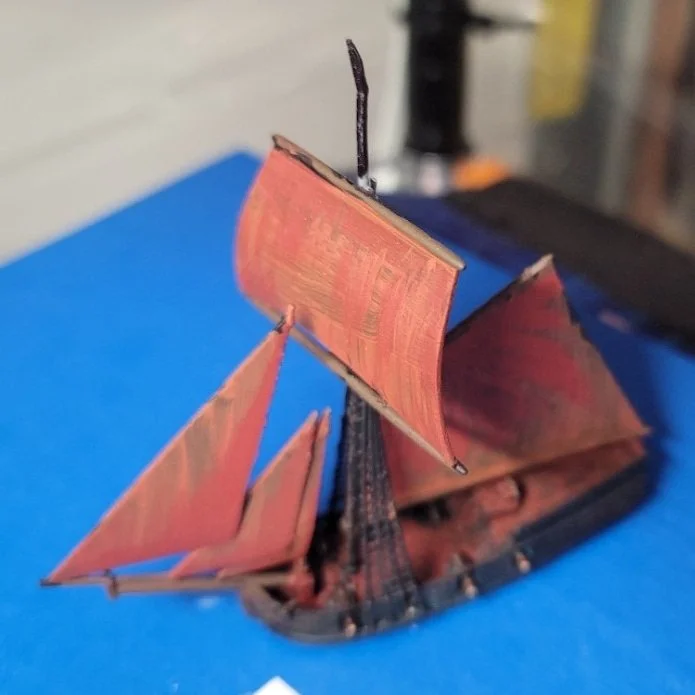
Take to the high seas with this tabletop gaming sloop! Armed with 8 cannon, this sloop represents a small, fast, but powerful ship of war! Great for representing a privateer, a pirate, or a small naval vessel. These kits comes un-painted, and un-assembled.
This kit is available two versions: The original has a more plain transom, the other is more stylized.
6MM scale Captain’s Edition : This is the latest 6MM version of this kit featuring MSLA resin 3D printed hull, masts, shrouds and sails. The kit features an improved resin that has high detail but maintains part flexibility. The goal of the Captain’s Edition is to get a model on the table for gameplay in a faster manner then previous versions. This model comes unpainted and unassembled.
Historic ship type:
Sloops originated from from small speedy vessels like the Dutch Yachts, and then evolved highly in Bermuda and the Caribbean , and along the Chesapeake bay. Sloops made excellent small warships as they sail upwind well and are small enough to operate in coastal waters as well.
Buccaneers were a community of all nations including Caribbean tribes, escaped slaves, criminals and outcasts, privateers and pirates operating in the Caribbean Sea during the 17th and 18th centuries. They originally are referenced early as 1625 on northwest side of Hispaniola after the devastations of Osorio, and their heyday was during the Restoration Era from 1660 until about 1688 -due to events in Europe, colonial governments in the Caribbean were not strong enough as locally established naval powers to suppress them. While Hispaniola was the original home of the buccaneers, Martinique for example was a home port for a large French buccaneers community.
The original term Buccaneer referred to hunters of wild boars and cattle in the largely uninhabited areas of Tortuga and Hispaniola. The meat they caught was smoked over a slow fire in little huts the French called boucans to make “viande boucanée” – basically jerked meat they sold to the pirates and privateers who preyed on the (largely Spanish) shipping and settlements of the Caribbean. Later the term was applied to the privateers themselves, also known as the ‘Brethren of the Coast.’
The yacht, a Dutch design for an armed personal craft of the wealthy and leaders of Europe, started to see wide use and progressed to the sloop. Whereas the original yachts had drop leeboards, Bermuda began progressing similar ships with no leeboards and a gaff rig. These sloops were referred to as “Bermuda rigged.”
A large Bermuda rig sloop was the perfect ship for a privateer or pirate. Sloops were fast, and able to operate in or around the coasts and inlets. This model looks to represent a large heavily armed for it’s size Buccaneer sloop, with a high bulkhead for additional crew protection.

These 14 pages have everything a Sailpower player would need to reference during the running of a general game . No more flipping through books to find a rule or chart. These are ‘dinner place-mat’ sized charts that are large enough to place die rolls directly on the gun charts for easy damage calculation.
The Sailpower 2.1 Quick Rules Reference Sheets contains:
the Sailpower Turn Sequence
Setting and Changing Wind Direction and Speed
Gun Charts for all Sailpower gun types
EXCLUSIVE: Newly Expanded Treasure System with 100 Treasures (50 additional over base rules)
EXCLUSIVE: Preferred ports (worth double) for treasures adds more risk vs reward choices for the player to consider as Captain
Grappling/Boarding/Small Arms rules
Mortar rules
Port Rules, Trading, and the Notorious Tavern Rules
Ramming, including T-Bone, Glancing Ram, and Head On
and MORE!
The intention is to be a quick go to to keep game play moving. The core Sailpower 2.0 Rule book is important as it contains more detailed and additional rules for game play, but the Sailpower 2.1 Quick Rules Reference Sheets make a great companion!
NOTE: This version of the Quick Rules is current to the Sailpower 2.0 edition. The Sailpower Treasure and Quick Reference Card Collections reflect updated stats for some weapons and charts that will be featured in a future edition of the Sailpower rules.
PRO TIP: Buy more sets for a bigger game! for a large 15MM game board we find that while players can share this set, it’s a great idea to have a set every 6 feet or so (or every 2 or 3 players). For 6MM gaming on a 6’x30” table we use one set for each side of the table and we like to use a TV tray that is short enough to push under the play surface and can easily be pulled out when needed.
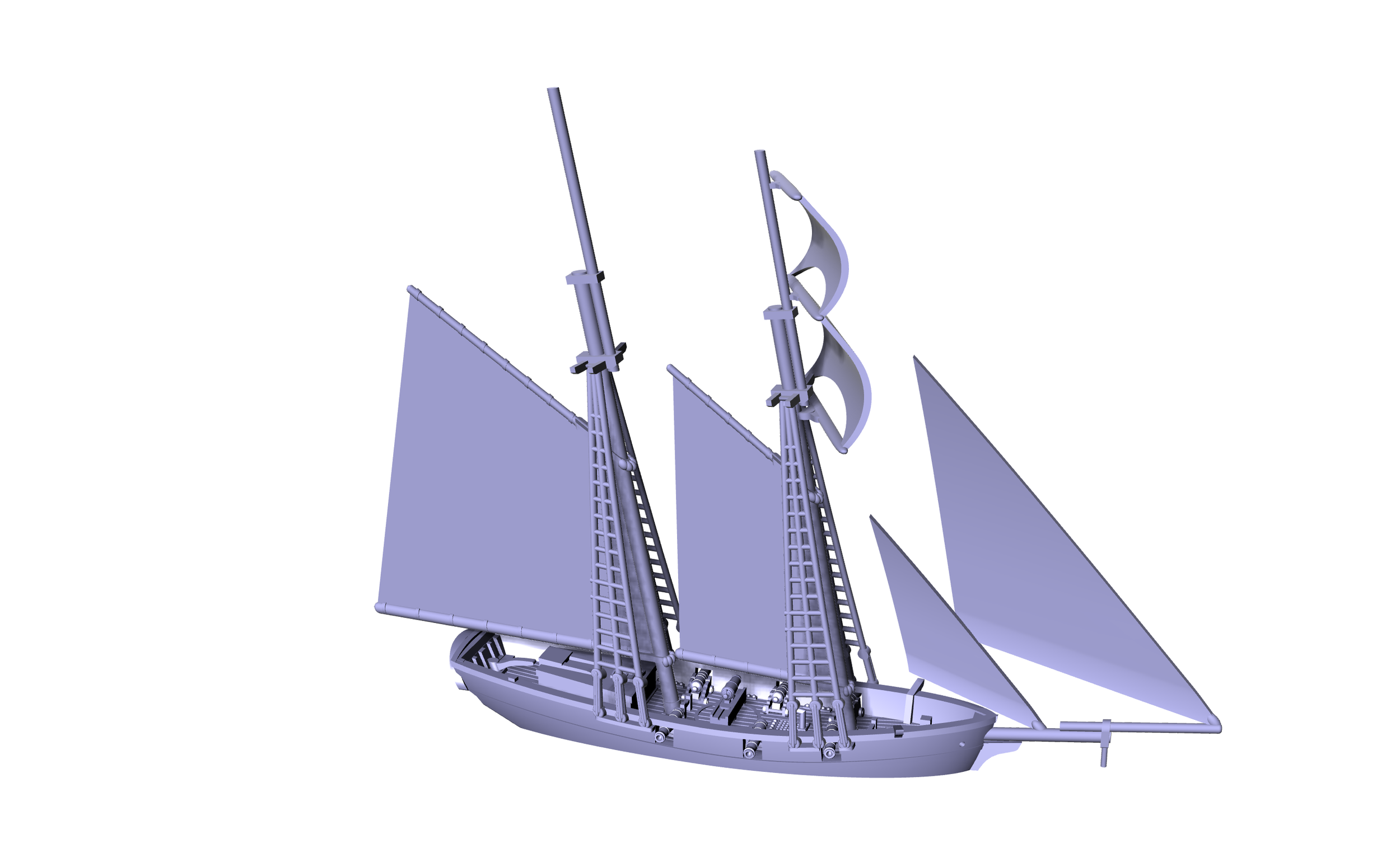
If you need a fast schooner for your Sailpower or other 6MM scale age of Sail game this kit with it’s rakish Baltimore rig looks fast sitting still!
6MM scale Captain’s Edition : This is the latest 6MM version of this kit featuring MSLA resin 3D printed hull, masts, shrouds and sails. The kit features an improved resin that has high detail but maintains part flexibility. The goal of the Captain’s Edition is to get a model on the table for gameplay in a faster manner then previous versions. This kit is sold unassembled and unpainted.
6MM scale HarborMaster Edition : This is a legacy version of this kit. 3D printed in Hi Res SLA, featuring wood and floral wire mast construction. The kit comes unpainted and unassembled. This kit type is ideal for more skilled modelers who plan to rig and/or make make sail prom paper, or want to reflect the ship as it would appear in a harbor not under sail. If this version is out of stock it may be available by contacting us for a special order.
Historic ship type:
Baltimore clippers also occasionally referred to as Baltimore flyers were small, fast sailing topsail schooner or brigantine rigged vessels used for trade around the coastlines of the United States and the Caribbean Islands and as privateers and letters of marque. They were also used as small warships, and later became the basis of coast guard cutters. Their hull-lines tended to be very sharp, with a "V"-shaped cross-section below the waterline and strongly raked stem, stern posts, and masts. The need for speed developed over time and also likely was driven by the desire to run blockades along the Atlantic cost and elsewhere.
By the late 18th century the Baltimore configuration was not only popular in the United States as merchant craft built in Britain as well. The Royal Navy initially avoided them as they were less stable as gun platforms due to their design for extreme speed vs a comparable brig-sloop. Also the schooner rig does not allow sails to be backed as easily, impacting maneuverability in close battle. They were later widely adopted on both sides of the Atlantic to enforce slave trade bans passed in 1807/1808.
Fell's Point shipyards became best known for producing these topsail schooners. During the War of 1812 (1812-1815), Fells Point's yards built and supported many privateers as well as letter of marque merchants, which ran the blockades, executing dangerous but much needed trade runs, as well as preyed on British shipping vessels. Consequently, Baltimore became a principal target of the British during the war, which eventually led to the attack on the city and the bombardment of Fort McHenry in September 1814.
This particular clipper is a patterned after a drawing produced by US naval architect William Doughty to serve as coast guard cutters, but would be typical of many small privateers of the war of 1812.
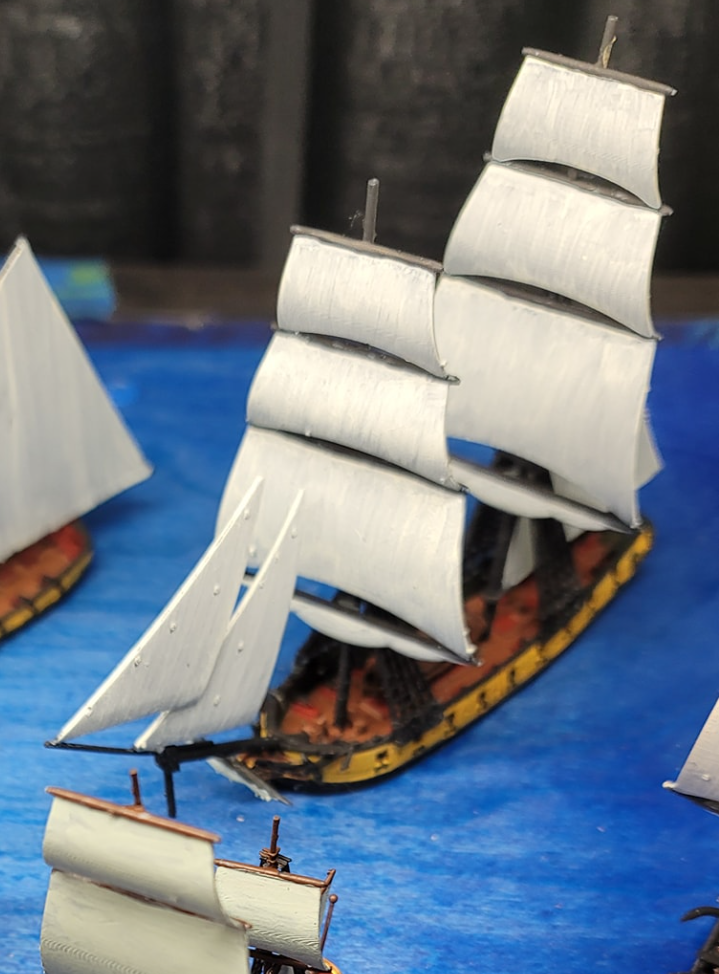
Take to the high seas with this tabletop gaming 180gun brig-sloop of war miniature! She is armed with 18 heavy carronades, and 2 medium long chase guns. This kit comes un-painted, and un-assembled. The ship hull measures 10 x 2.75 centimeters and is suited for 5 to 6MM scale war gaming.
This kit is based on USS Argus and or USS Syren but can easily be used to represent any period brig sloop of war . Brig Sloops like this were the destroyers of the era … small but fast and powerful!
6MM scale Captain’s Edition : This is the latest 6MM version of this kit featuring MSLA resin 3D printed hull, masts, shrouds and sails. The kit features an improved resin that has high detail but maintains part flexibility. The goal of the Captain’s Edition is to get a model on the table for gameplay in a faster manner then previous versions.
Historic ship type:
USS Argus was built in 1803, and served with distinction for a decade, with Action in Tripoli, the Barbary wars, and the War of 1812.
She was the ship of Marine legend Lieutenant Presley O'Bannon, who stormed the batteries of Derna after Argus and the squadron with her had silenced the city’s guns.
During the War of 1812, she cruised the Atlantic coast taking six prizes while evading a British squadron for 3 days! She then broke out of blockade at New York and carried diplomatic officials to France before setting sail on a commerce raiding cruise where she captured and burned 19 vessels before her luck ran out. Exhaustion, and perhaps, overconsumption of wine from her last prize made the crew less then up to fighting shape when HMS Pelican spotted the smoke from her final burning prize.
Pelican had been sent to hunt down Argus to stop the massive destruction of shipping that was making insurance rates sky high! With the lucky spotting of the smoke, Pelican was able to close in. Argus was lighter armed but chose to fight rather then run despite being faster and able to escape. Thus, Argus was captured, ending her career August 14, 1813.
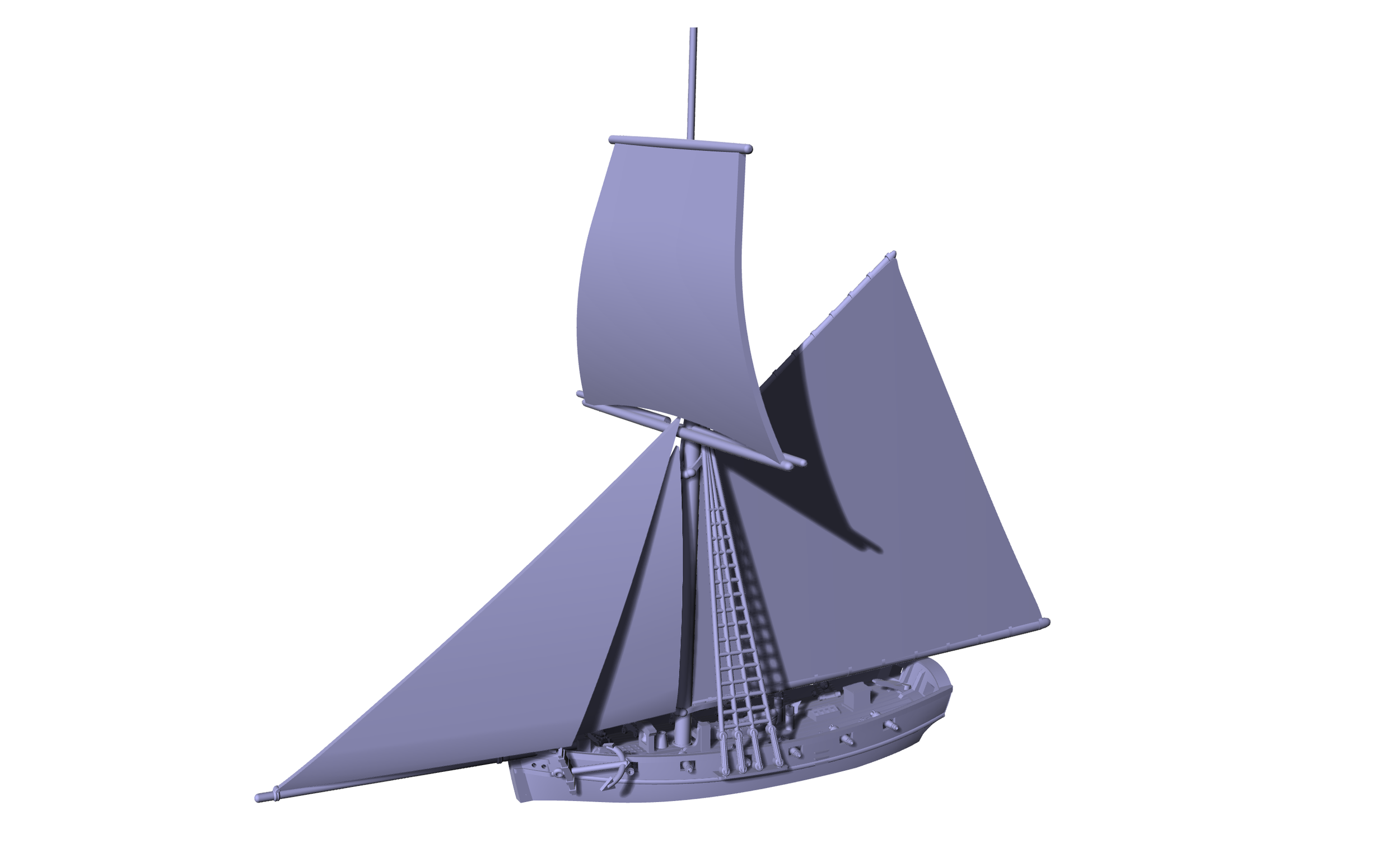
Is your fleet in need of a small cutter for patrolling, sending messages, and enforcing customs? The 12 gun dispatch and revenue cutter is based largely on the Cheerful class and more specifically a nice model seen in the US Naval academy museum. This model is typical of cutters for the latter part of the age of sail (In Sailpower this fits best in Age of revolutions or AoR games). This kit would be well suited to represent any royal navy cutter of the Napoleonic era, as well as the War of 1812.
There are several versions of this kit:
6MM scale Captain’s Edition : This is the latest 6MM version of this kit featuring MSLA resin 3D printed hull, masts, shrouds and sails. The kit features an improved resin that has high detail but maintains part flexibility. The goal of the Captain’s Edition is to get a model on the table for gameplay in a faster manner then previous versions. This model comes unpainted and unassembled.
15-20 mm quick build version:
This kit is designed to be easy to build and features a 1 piece hull with the guns printed in place. Assembly is limited to putting the masts together and painting. Kit includes the hull, dowels and mast fittings, and directions.
Historic ship type:
It’s likely a sign of English humor that the lead ship of the class was named Cheerful and her sister ship was named Surly. Such names seem ill suited and even ironic for a vessel that while fast and essential to the service, would have been challenging to sail, and very wet due the open deck and low freeboard, and uncomfortable to serve aboard as she did not have a full height underdeck.
The historic Cheerful was built at Dover in 1806 and designed by Sir John Henslow. It was a typical purpose-built cutter used for patrolling and scouting. Cutters were also used to carry important dispatches, and military orders around to the various reaches of the English naval presence. Cutters such as this were also used for customs work and to interdict smugglers. Cutters carried more sail then a typical sloop and were very fast.

3D printed in FDM, this kit comes unpainted and unassembled, but will make a nice way to indicate the wind for your Sailpower board. Assembled, it is about 16cm (6.25 inches) in diameter
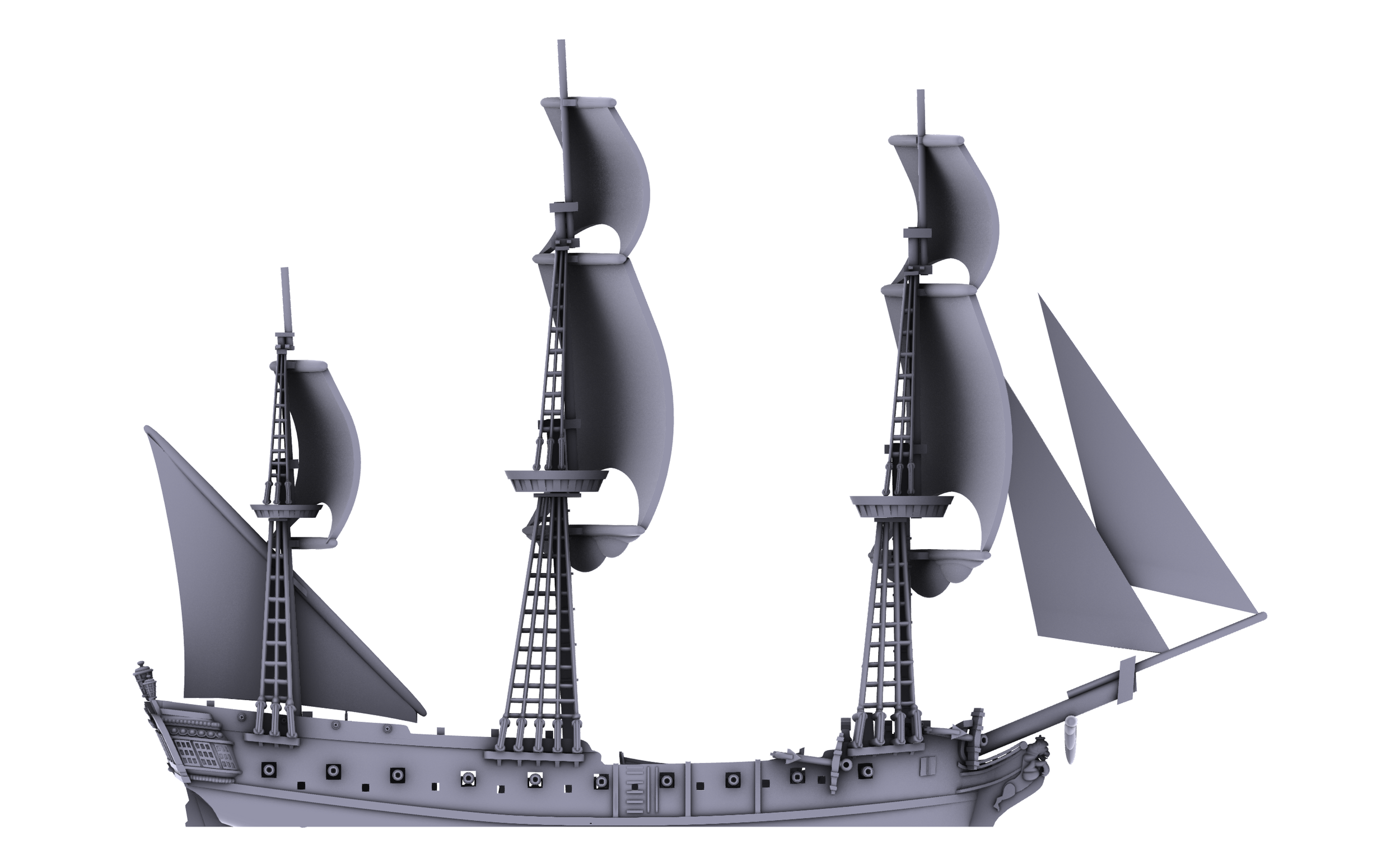
Does your Age of Pirate game need a fast heavily armed man o war? The Galley frigate was a powerful light warship of the early 1700's. Designed to be narrow and fast, and equipped with long oars called sweeps. These ships quickly became popular among navies, among privateers, and even merchants. This model closely replicates the Queen Anne’s Revenge although it can be used to represent many different galley frigates if the era.
6MM scale Captain’s Edition : This is the latest 6MM version of this kit featuring MSLA resin 3D printed hull, masts, shrouds and sails. The kit features an improved resin that has high detail but maintains part flexibility. The goal of the Captain’s Edition is to get a model on the table for gameplay in a faster manner then previous versions. This kit is sold unassembled and unpainted.
Historic ship type:
Most pirates used small ships such as sloop or brigantines but the famed pirate Blackbeard knew the galley frigate was a powerful yet fast warships and wanted to get his hands on one. As he only had a small squadron of sloops, rather then go after a fully armed naval version he set his sights on a merchant version which tended to be comparatively under-armed and undermanned.
His eventual capture was of the French galley La Concord. He named her Queen Anne’s Revenge (often referred to as QAR for short) quickly scaled the ships armament up to reportedly as many as 40 guns. Eventually, after a reign of terror on the high seas including using QAR to blockade Charleston for ransom, the ship ran aground, and Blackbeard chose to abandon her and return to a smaller sloop.
Pirates were not the only captains to employ heavily armed galley frigates. Famed privateer, and later pirate hunter, Woodes Rogers used them to great effect both with purpose built naval galleys as well as up-armed merchant galleys.

6MM scale Captain’s Edition : This is the latest 6MM version of this kit featuring MSLA resin 3D printed hull, masts, shrouds and sails. The kit features an improved resin that has high detail but maintains part flexibility. The goal of the Captain’s Edition is to get a model on the table for gameplay in a faster manner then previous versions.
6MM scale HarborMaster Edition : This is a legacy version of this kit. 3D printed in Hi Res SLA, featuring wood and floral wire mast construction. The kit comes unpainted and unassembled. This kit type is ideal for more skilled modelers who plan to rig and/or make make sail prom paper, or want to reflect the ship as it would appear in a harbor not under sail. If this version is out of stock it may be available by contacting us for a special order. There are two hull variants available - with carronades or with carriage cannons
All Model kits comes unpainted.
A felucca is a sailing craft native to the Mediterranean and used by the forces of Tripoli and the Barabary coast. The were also used by almost every navy operating in the Med, particularly by Catalan, French, Spanish, Portuguese, and Italian forces. A smaller cousin to the Xebec, These boats have been used since antiquity. While their days of corsair and naval work are over they still can be found today as leisure craft and some working feluccas can still be seen in various corners of the Mediterranean.
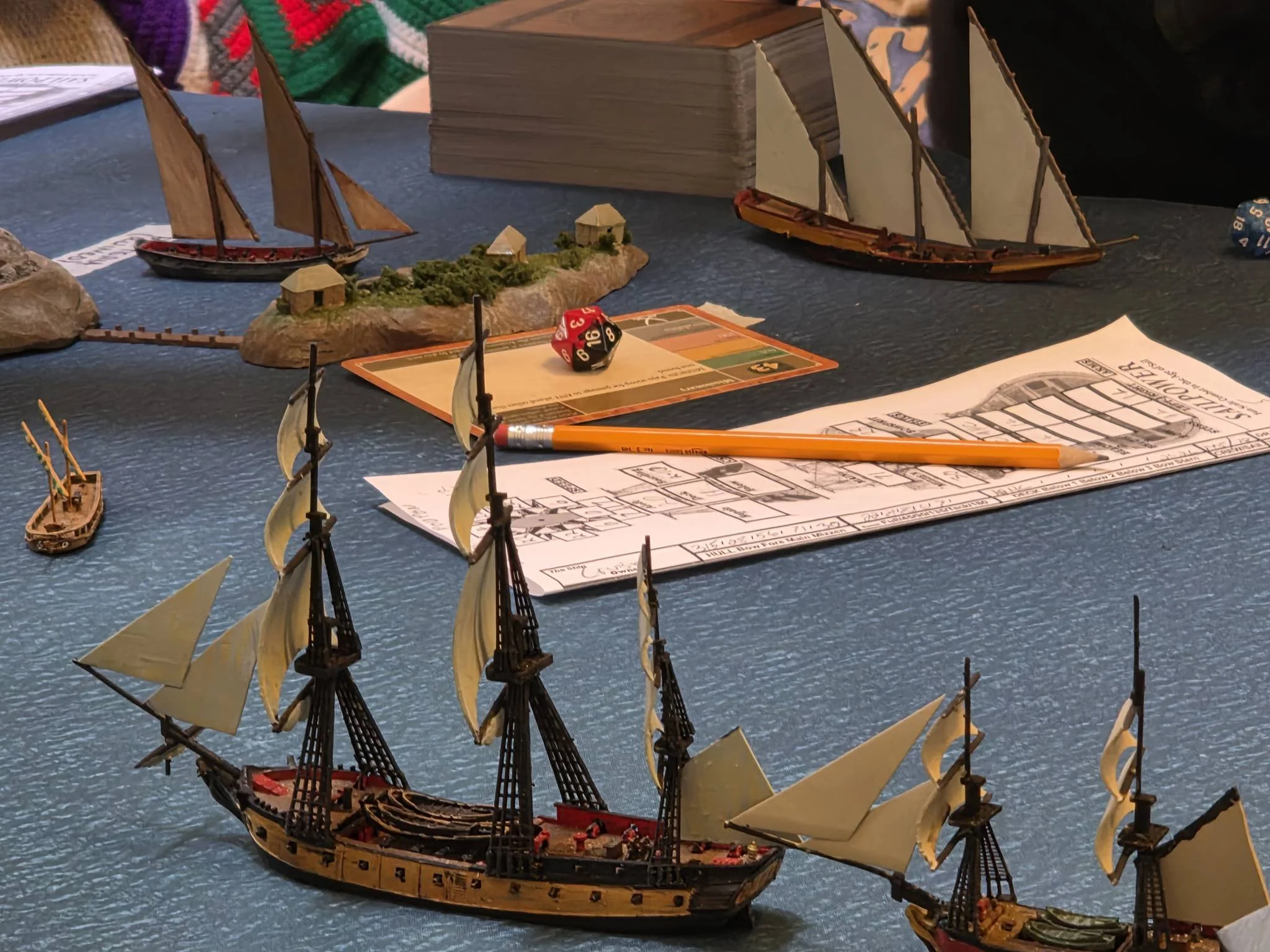
A representative 5th rate Frigate for your Sailpower game or other 6MM scale age of sail needs!
6MM scale Captain’s Edition : This is the latest 6MM version of this kit featuring MSLA resin 3D printed hull, masts, shrouds and sails. The kit features an improved resin that has high detail but maintains part flexibility. The goal of the Captain’s Edition is to get a model on the table for gameplay in a faster manner then previous versions. They come unpainted and unassembled.
Historic ship type:
When the navy designers initially created 5th rates, they had two decks, but they found lower decks to be hard to arm, as the guns were too close to the waterline to be operated in rolling seas. Later fifth rates evolved into Frigates, essential for projecting power around the world as they were capable of extended independent operation Fifth Rates were often excluded from the larger lines of battle as they were considered too small but operated very well in squadrons. The middle of the 1700’s saw the introduction of a new fifth-rate type—the classic frigate, with no ports on the lower deck, and the main battery disposed solely on the upper deck, where it could be fought in all weather.
These Fifth-rate frigates served as fast scouts or independent cruisers, or sometimes ran in small squadrons and included a variety of gun arrangements with crews of 215 to 294 men.
To be posted aboard a fifth-rate ship was considered an attractive assignment. Fifth rates were often assigned to interdict enemy shipping, offering the prospect of prize money for the crew. Fifth-rate frigates were considered useful for their combination of maneuverability and firepower and were commonly used in patrol and to disrupt the enemy.
These models are designed to represent a typical 5th rate frigate of the 1700’s. These frigates featured 32 to 38 guns and depending on the year would mount 12 pounders or in later cases 18 pounders. Their quarter decks would be armed with smaller 6 pounder guns and later, carronades.

6MM scale Captain’s Edition : This is the latest 6MM version of this kit featuring MSLA resin 3D printed hull, masts, shrouds and sails. The kit features an improved resin that has high detail but maintains part flexibility. The goal of the Captain’s Edition is to get a model on the table for gameplay in a faster manner then previous versions. There are two hull variants available -armed with Carronade, and armed with Cannons.
6MM scale HarborMaster Edition : This is a legacy version of this kit. 3D printed in Hi Res SLA, featuring wood and floral wire mast construction. The kit comes unpainted and unassembled. This kit type is ideal for more skilled modelers who plan to rig and/or make make sail prom paper, or want to reflect the ship as it would appear in a harbor not under sail. If this version is out of stock it may be available by contacting us for a special order. There are three hull variants available -Carronade armed, Cannons with round gun ports, and Cannon with side opening square gun ports.
Our Xebec model represents a 14-gun mid-sized xebec. The model comes unpainted and un-assembled.
This model’s hull including the beakhead and stern overhanging poop deck is just over 146mm long by 25mm wide.
Xebecs, seen throughout the Mediterranean throughout the age of sail were easy to produce and were cheap, and thus were used as merchants, but more famously as corsairs and pirates. Every major naval power with forces in the Med also operated them. Xebecs became the preferred ships of Barbary pirates for the ability to carry more cannons than a galley, and overall cheapness, speed, and maneuverability.
Corsairs built their xebecs to achieve higher speed than their victims, but with a considerable beam to allow for the large sails. The lateen rig of the xebec allowed the ship to sail close hauled to the wind, often giving it an advantage in pursuit or escape. The use of oars or sweeps allowed the xebec to approach vessels who were becalmed.
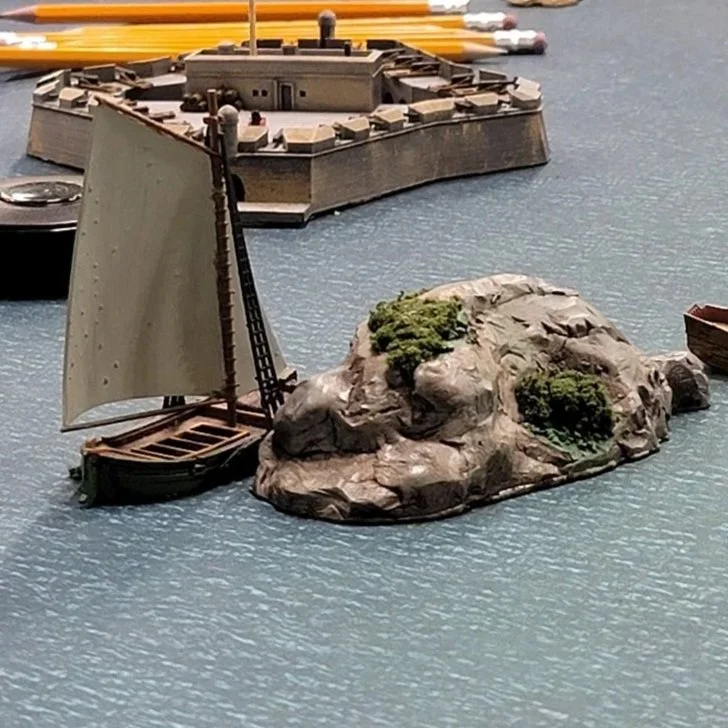
Need a small fisherman or coastal vessel for your game board?
6MM scale Captain’s Edition : This is the latest 6MM version of this kit featuring MSLA resin 3D printed hull, masts, shrouds and sails. The kit features an improved resin that has high detail but maintains part flexibility. The goal of the Captain’s Edition is to get a model on the table for gameplay in a faster manner then previous versions. This model comes unpainted and unassembled.
Historic ship type:
A hoy is a small gaff or sloop-rigged coasting ship used for fishing, or small cargo hauls. They are fairy small, usually of a burthen of about 60 tons (bm). They tended to be wide on the beam and shallow drafted, relying on the steerboard to stay on course under sail. This version is gaff rigged and has the distinctive Dutch steerboards. The word derives from the Middle Dutch word "hoey." While originating with the Dutch, the Hoy evolved over time, and was also used by the English in large numbers. This model is intended to represent a unarmed version of our Dutch Gunboat model.
This model is 3d printed in SLA resin and comes unpainted and unassembled.

Swedish / Danish Gunboat (After the Fredrik Henrik af Chapman design used in the gunboat wars)
Looking for a gunboat or armed row galley for your game? We present out 6MM model of the gunboat design that dared to confront major navies and influenced gunboat design around the world! Our 6MM scale models are 3D printed in hi res SLA resin, and features optional floral wire masts. The gunboats are sold as a set of two, with one gunboat cleared for action both fore and aft, and the other with the bow doors in place which would improve seaworthiness during maneuver.
Kanonslup (literally translated “cannon sloop”) or Kanonchaluppen (literally Canon shalop) were the larger type of gunboats for use in the shallow northern waters after pair of original designs by Fredrik Henrik af Chapman in 1775. Each of these larger gunboats was armed with two 24-pounder cannon (Chapmans original design called for 18 pounders) and four 4-pounder howitzers and had a wartime crew of 69 – 79. This design was copied and mass-produced in Russia, Denmark and Norway. The design also influenced similar designs in England, the United States, and other naval powers.
The Gunboat War of 1807-1814 was a result of the British capture or scuttling of large parts of the Danish-Norwegian fleet during a naval assault on Copenhagen. Facing having no navy to defend against English royal navy aggression, the Dano-Norwegian government decided to build gunboats in large numbers to compensate for the loss. The strategic advantage of gunboats lay in the fact that they could be produced rapidly and inexpensively throughout the kingdom. The tactical advantages were that they were highly maneuverable, especially in still and shallow waters and presented small targets. During the war the Danish-Norwegian government produced more than 200 gunboats.
As an example of gunboat daring one need only take the case of the capture of HMS Tickler. On June 4th, 1808, the brig encountered four Danish gunboats rowing towards her. A lack of wind prevented Tickler from maneuvering and gave the gunboats an advantage. The gunboats opened fire at 2:45p.m., and Tickler responded with her bow chasers. Five hours later Tickler was forced to surrender. and suffered one man killed and seven men wounded, while her hull was riddled with holes and her rigging was in tatters. Danish casualties were reportedly minimal.
A squadron of 16 gunboats later captured HMS Tigress, and a fleet of 25 gunboats made a daring attack on the 64-gun HMS Africa and only escaped capture due to the fall of night. Encounters between gunboats and larger Royal navy vessels happened throughout the war.
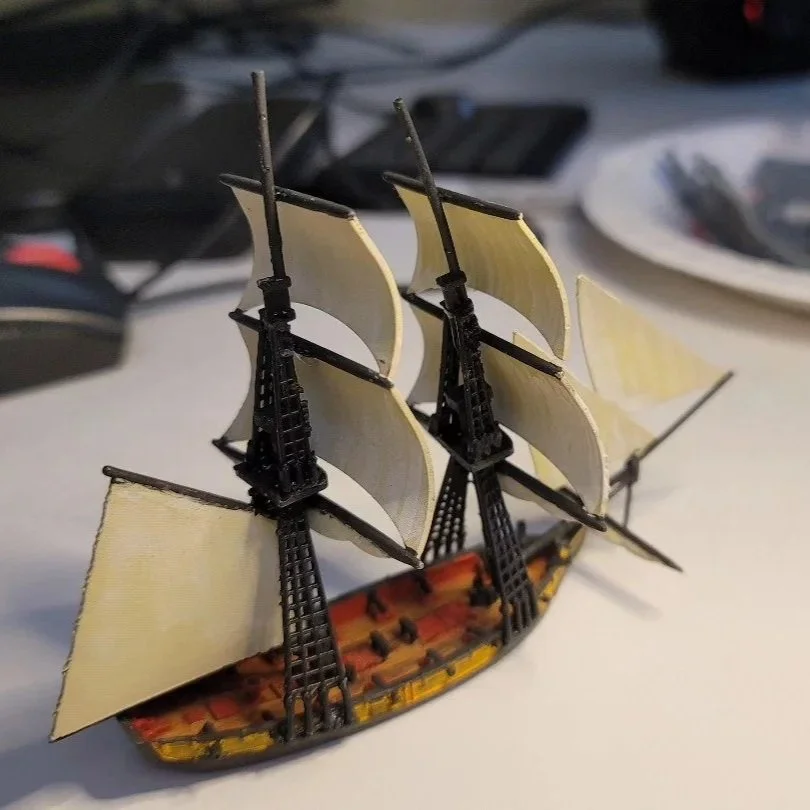
Play this legendary Gun Brig in Sailpwer or other 6MM age of sail games!
6MM scale Captain’s Edition : This is the latest 6MM version of this kit featuring MSLA resin 3D printed hull, masts, shrouds and sails. The kit features an improved resin that has high detail but maintains part flexibility. The goal of the Captain’s Edition is to get a model on the table for gameplay in a faster manner then previous versions. This model comes unpainted and unassembled.
Historic ship type:
The Speedy class was designed in 1781 by shipbuilder Thomas King. “Gun-brigs” like this were designed with a cutter style hull, part of the development of a new concept of the brig in naval warfare. This concept saw brigs as small, fast escort vessels, instead of the slower, larger brig and ship-sloops of war.
The two ships of this innovative class were named to epitomize this approach. HMS Speedy, and HMS Flirt were small, light craft, at a mere 207 Tons burden, and measured 78 feet on deck. Armed with light cannons (4 pounders) and many swivels for close in work.
Speedy was transferred to the Mediterranean after the outbreak of the French Revolutionary Wars. She had several notable commanders, winning fame for herself in various engagements -often against heavy odds.
Her first commander in the Mediterranean was Charles Cunningham, who served with distinction with several squadrons, assisting in the capture of several war prizes, such as the French frigates Modeste and Impérieuse. His successor, George Cockburn, is noted for his dogged devotion to duty. Speedy's next commander, George Eyre, had the misfortune to lose her to a superior French force on 9 June 1794.
She was soon retaken, and re-entered service under Hugh Downman, who captured several privateers between 1795 and 1799 and fought off an attack by the large French privateer Papillon on 3 February 1798. His successor, Jahleel Brenton, fought several actions against Spanish forces off Gibraltar.
Her last captain, the famed Lord Cochrane was underwhelmed with his new command, declaring Speedy was "little more than a burlesque of a vessel of war". His cabin had only 5 feet of headroom, thus when Cochrane wished to shave, he had to open a skylight and set his shaving equipment out on the quarterdeck. On another occasion he walked the quarterdeck with Speedy's entire broadside, seven pieces of four-pounder shot, in his pockets. In an attempt to increase the firepower of his new command he asked for and was given two 12-pounder long guns to use as bow and stern chasers, but the scantlings could not support them, and they had to be removed. He then requested his 4-pounders be upgraded to 6-pounders, but his gunports were not big enough. He had better luck with his mast, taking a spar from HMS Genereux that was considered too large for Speedy, but which Cochrane felt improved her speed.
Despite all this, Cochrane used her to capture many vessels and conduct shore raids against the enemy coast. His most famous exploit in Speedy would come when he forced the surrender of the much larger Spanish frigate El Gamo, a xebec-frigate of 32 guns. A powerful French squadron captured her again in 1801 and Napoleon donated her to the Papal Navy the following year. She spent then finished her career with five years with the Papal Navy under the name San Paulo.
What period does Sailpower cover?
Sailpower covers the Age of Sail, from post cog to the the pre steam era, -or approximately the late Elizabethan thru Napoleonic eras. The cannons are abstracted in a general way so that ships from differing era can be played together, or you can choose what era you want to focus on. Sailpower is perfect for Golden age pirate scenarios, War of 1812, Napoleonics, American Revolution, or even Barbary Coast pirate actions. You can even incorporate Sailpower into a semi fantasy setting, although there are no fantasy rules in the core rulebook.
What scale is Sailpower?
Sailpower is playable in many scales, two of which are playable without conversion:
6mm Scale (approximately 1/300th or 1mm = 1 foot) Gameplay is measured in centimeters.
15-20mm Scale (approximately 1/100th or 1/8th inch = 1 foot) Gameplay is measured in inches.
Conversions are available to other scales.
Sailpower models are available in 6mm scale with select models in our original game scale of 15mm.
I don’t have much space. Can I still reasonably play Sailpower?
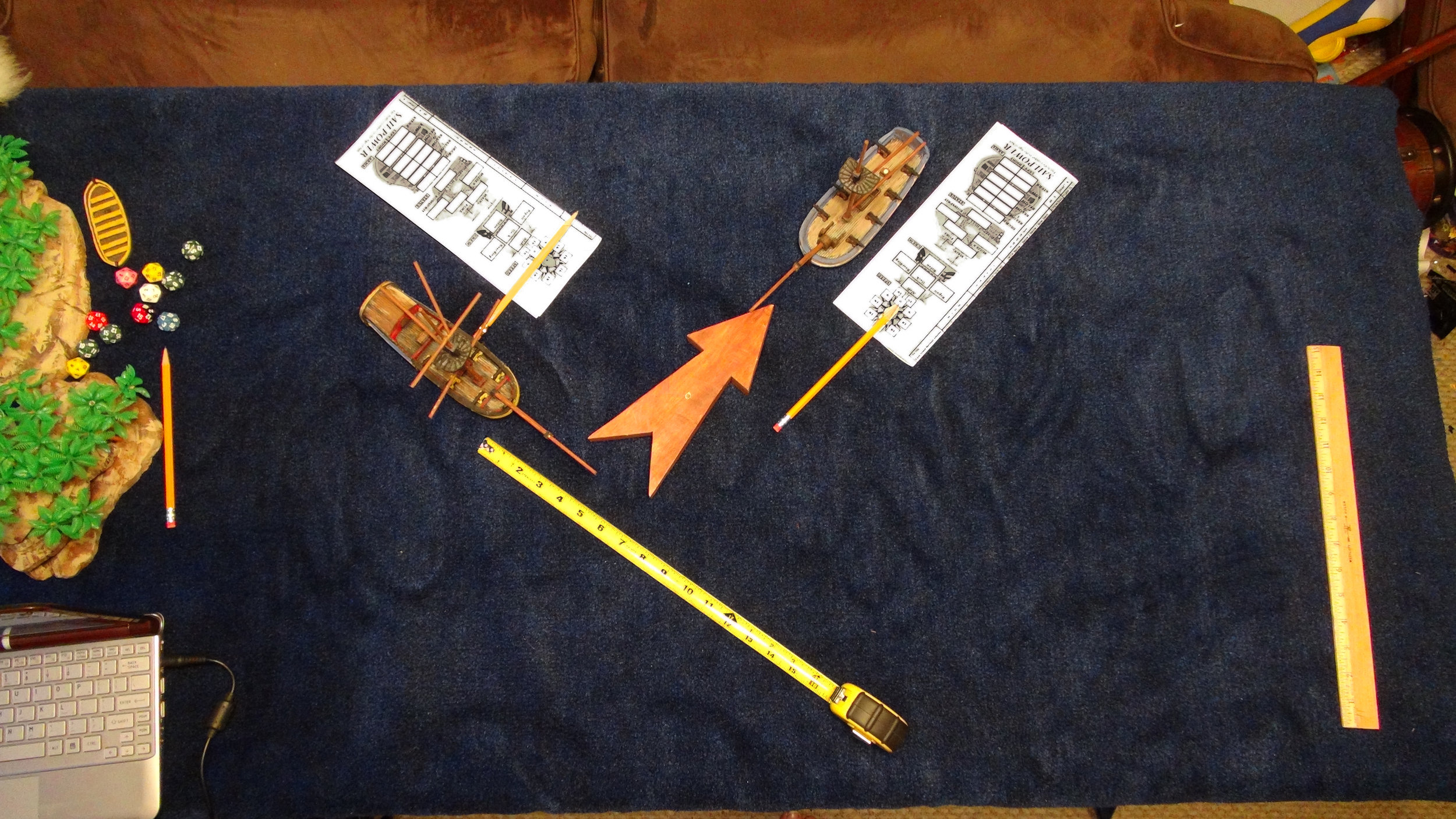
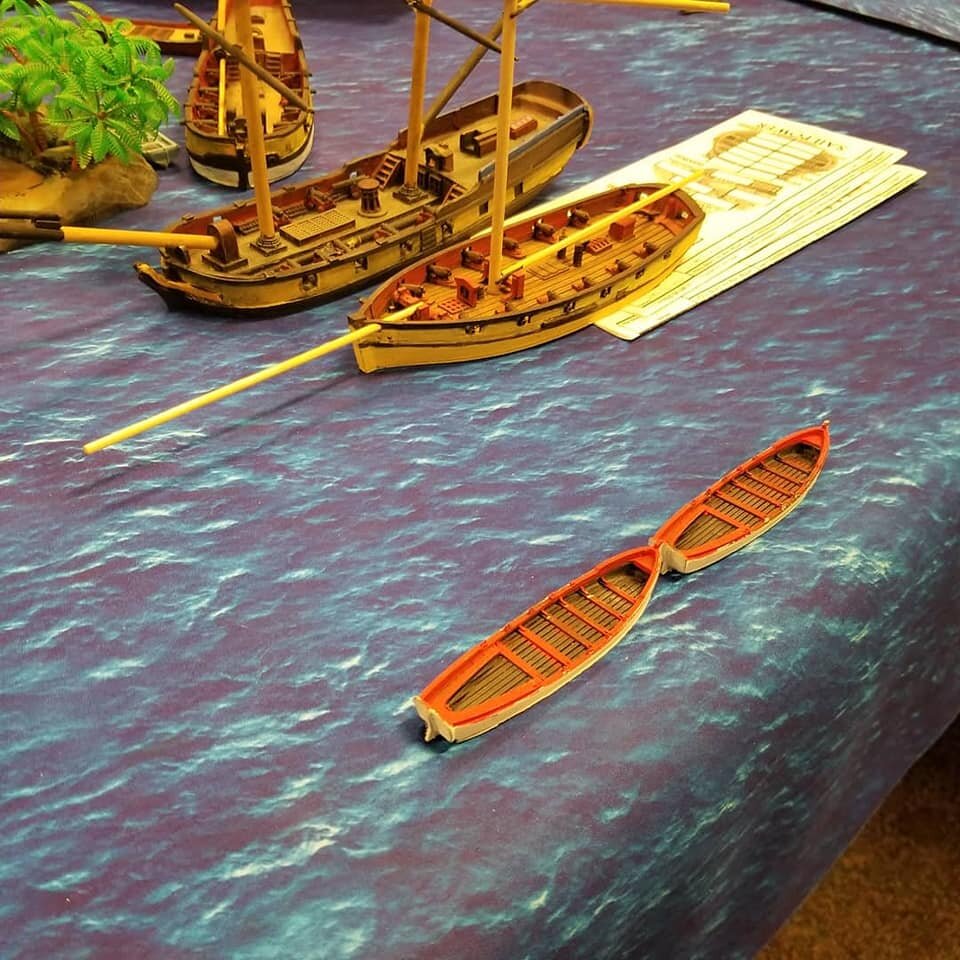
Yes, we tested the game heavily with small sloops and schooners on 3X3 and 4X4 coffee tables. If you want to use larger ships or have a lot more “sea space” you obviously will need more a larger table, but a battle of sloops on a coffee table is just as exciting as a pair of frigates, perhaps even more so!

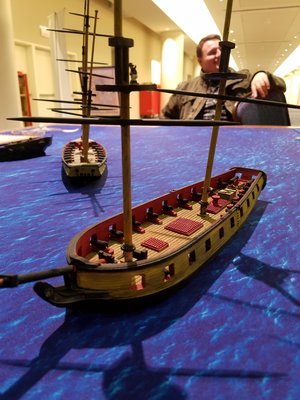
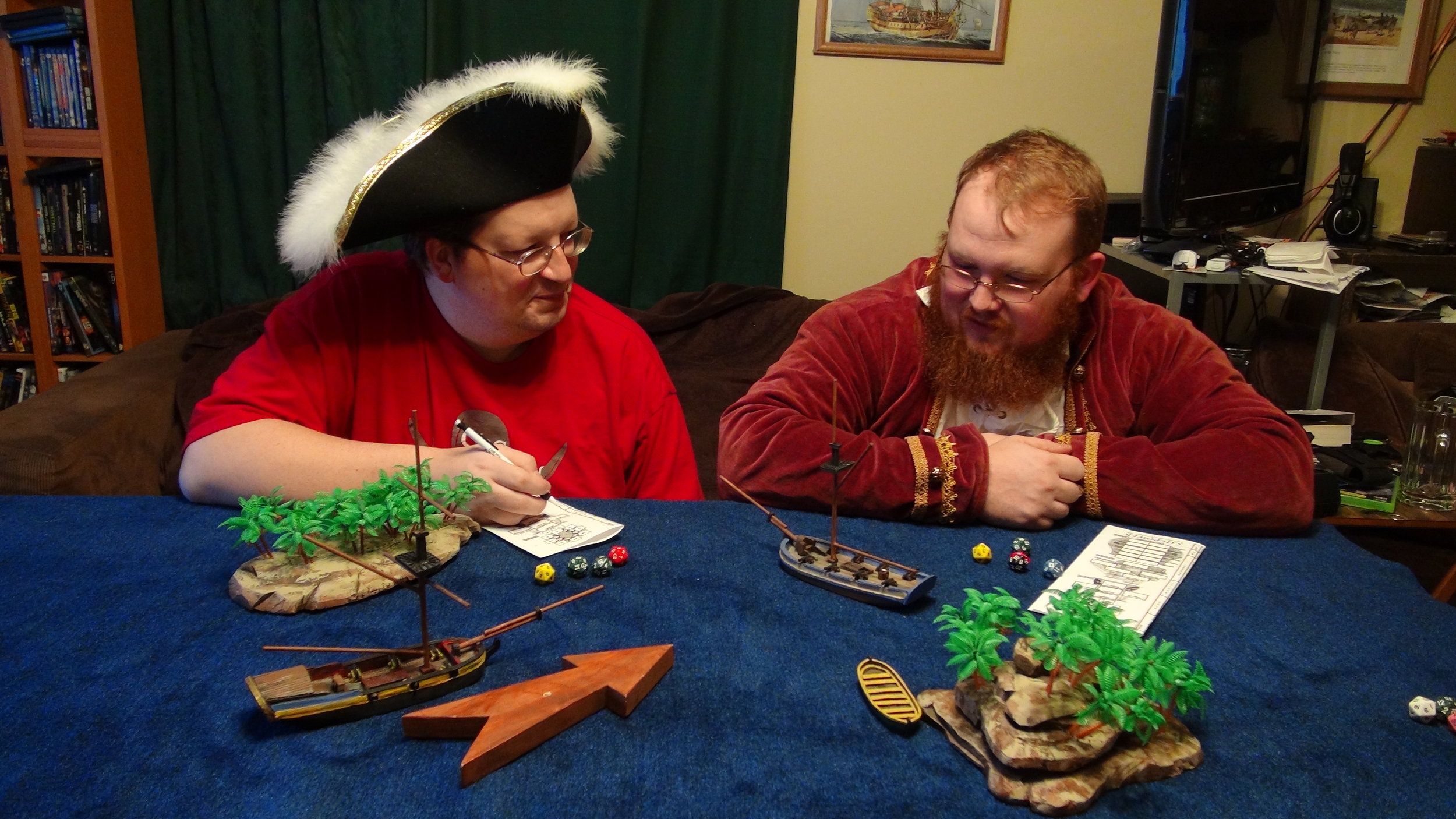
Recreate the High Adventure and Glory of The Age of Sail!
Are you the master of all commanders? Are you the scurviest of sea dogs? Have you ever secretly felt you’d have made a great pirate or could have defeated the great sea captains in a ship to ship duel?
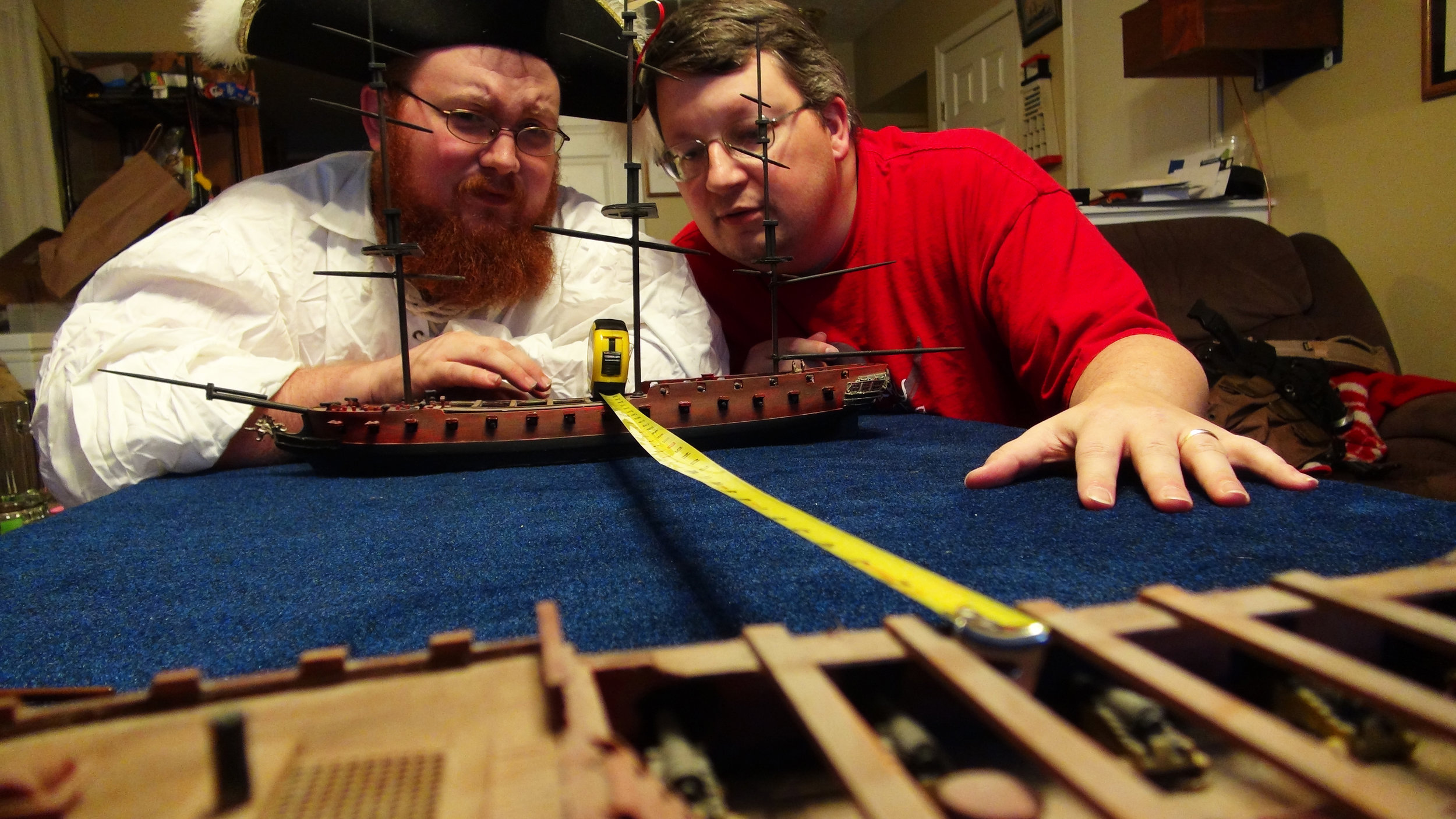
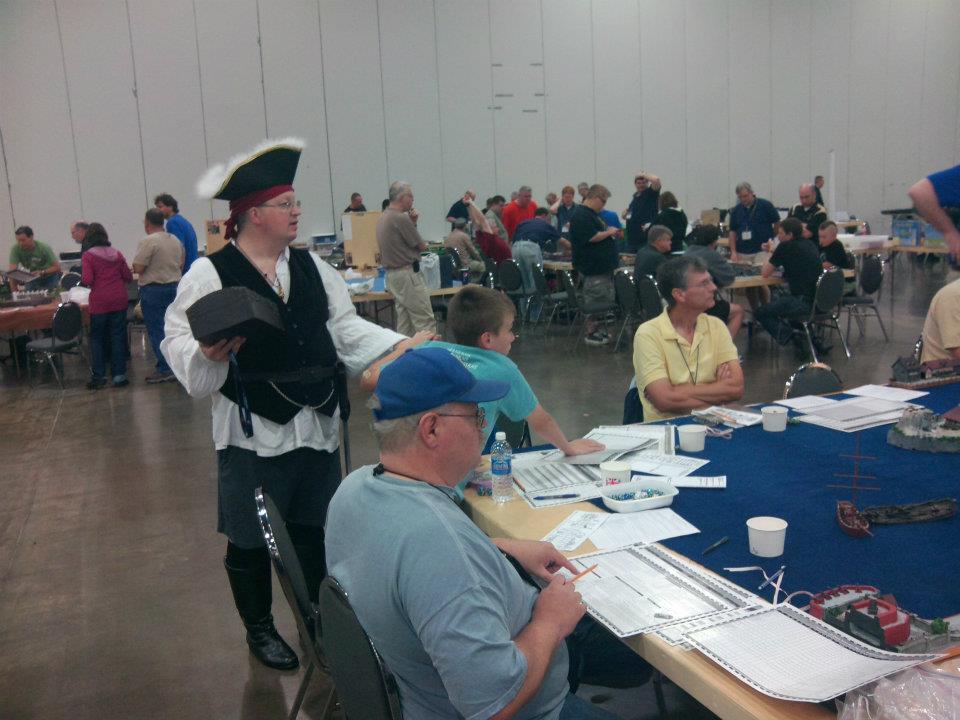
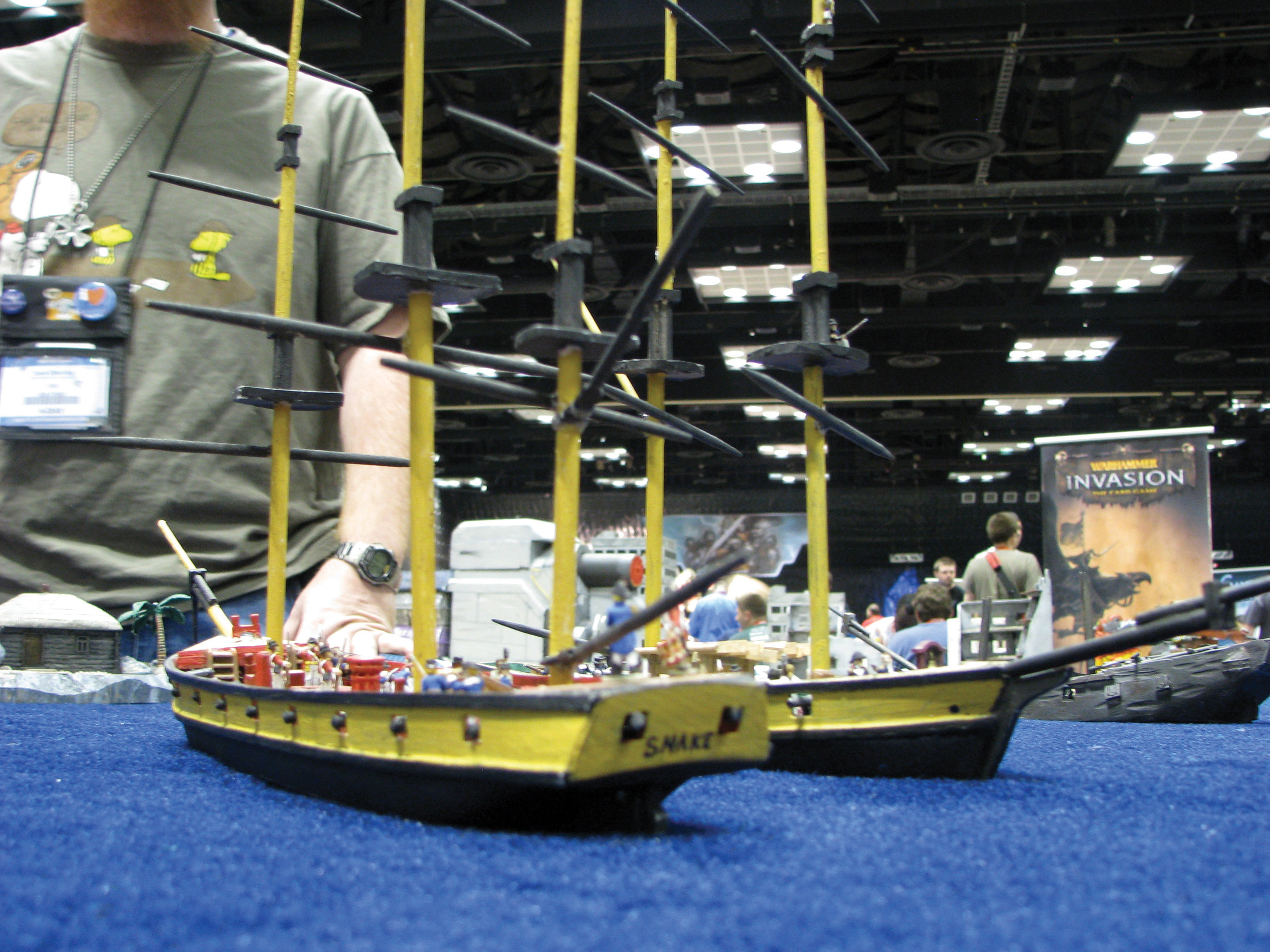
Sailpower is a miniatures game that allows the players to take on the role of a captain in the Age of Sail. Command small ships, large ships or even a whole squadron. It’s your call! Battle other ships, or embark on a mission seeking plunder and riches while giving your enemies the slip. Sailpower is a complete system designed to support fast paced sea action, exploration and adventure. You can play Sailpower on a small table with a couple of ships, a big table with many ships, or even a floor battle with your ?sea? covering the whole room!
Expanding the Great Adventure!
After 2 years of revisions and development, this second edition Sailpower rule book contains:
A fully revamped layout including revised and improved rules.
New gun types including light cannons, medium long guns and more types of shore batteries.
Expanded rules for small boats, forts and shore batteries including more effective hot shot!
Over 150 ship templates, including many historical ships from the Napoleonic, Revolutionary War, Golden Age of Pirates, War of 1812 eras (including ships from the Battle of Lake Erie).
Several versions of certain historical ships are provided to represent different points in the life of the vessel, such as when they first launched, when they were refitted, when they were up-gunned or captured.
All new expansive faction rules for many sea powers including the East India companies, the Dutch Navy, the Barbary Coast Pirates, and much more!
New rake rules, often player requested, add to the crossing the T maneuvering advantage.
New expansive port and tavern rule system, allowing players to recruit, buy and sell cargo, sneak into an enemy port, and even get into a bar fight!
A full exploration and treasure system allowing players to use shore parties to search various locales on the play-surface and find and or fight for all sorts of hidden goodies such as ship upgrades, exotic cargoes, additional crew, repair materials, stranded travelers, and epic treasures!
This Starter set includes:
- Sailpower 2.0 Deluxe edition rulebook (color)
Want the rules in a pdf?